Share a Coke: How Coca-Cola’s campaign goes viral

Coca Cola or Coke is one of the famous beverage brands in the world that have its presence it the market for more than a century. Everyone knows Coca Cola, and yet the company still spend massive amount of money each year on their marketing campaigns.

Recently, the sales in the Australian market has been declining, Coca Cola decided to do something different by introducing ‘Share A Coke‘ campaign in 2012 which aimed to increase their brand value and sales.

Image result for share a coke campaign viral

It’s been reported that the Australian consumers is somewhat ‘introvert’ and ‘egalitarian society’ which tend to not accept big brand until the brand thinks from their level of understanding. Coca Cola then tackle the problem by launching an innovative advertising campaign, manufacturing bottles that have most of the common Australian’s names printed on the them instead of their brand name.

Image result for share a coke campaign viral

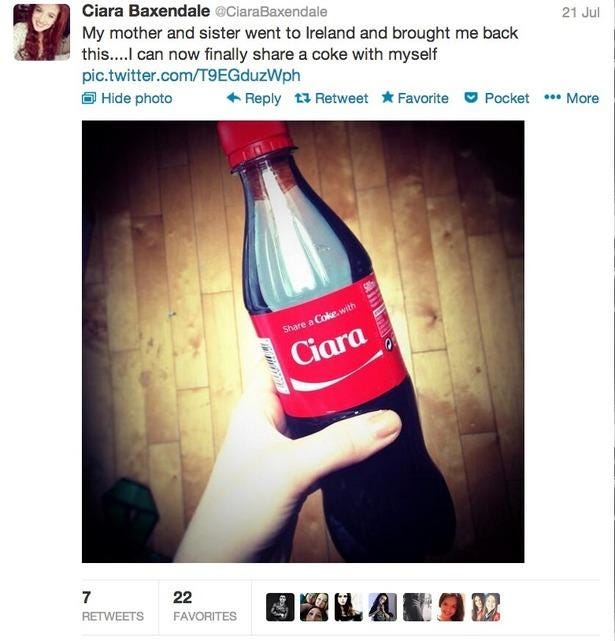
“Share A Coke” – first of its kind marketing campaign that aims to connect and strengthen the brand’s bond with young Australian, inspire them to share happy moments in the real and virtual worlds. Started with just only 150 names, the campaign went viral when consumers purchase the product and share it with their friends online with #ShareaCoke. Coca Cola’s emphasized on purchasing the product for someone else, hence the term “Share” a coke.

Emma Roberts on Instagram

Celebrities such as Emma Roberts as an opinion leaders on social media also helped promote the campaign by sharing a Coke with her friend on Instagram.

Through integrated marketing techniques, the brand successfully penetrated social media, retail spaces and outdoor advertising with its personalised “thing”. The campaign saw a massive success with 7% increase in Coke consumption. Starting from Australia, the campaign then made its way around the world by reaching more than 70 countries. During that time, Coke then became a ‘must -have’ object of desire for everyone.

Related image

It turns out that consumer love personalisation, by having their name on it or their friend’s name on it , they are more likely to purchase it and share it on social media.

Because the campaign use hashtag, consumers can share the campaign directly

As of April 2016, more than 600,000 pictures were shared using the #ShareaCoke on Instagram.

The campaign is the perfect example for WOM marketing, which is seen as the most effective ways to reach millennials. #ShareaCoke initiated WOM Marketing by producing spreadable content, people share a Coke with others, they spread the word. Consumers love to see their name attached with an iconic brand, such as on Coca Cola’s bottle. What is your thought about Coca Cola’s marketing strategies? Why do you think some consumers went crazy over this campaign? and what about yourself, would you buy it if you see your name printed on the bottle?
Google AdWords: should we be bidding?

Search engine:

Most of us use search engine at least once a day. While there are few different search engines out there, by far ‘Google’ is the most popular search engine followed by chinese search engine ‘Baidu’.
Search engines serves millions of users per day,

  • Google receives over 63,000 searches per second which translates into at least 2 trillion searches per year.
  • According to Statista, Google’s ad revenue amounted to almost $95.4 billion in 2017, that is 25% up from 2016.

The search giant now has 90.4% of the global search engine market share, it is no doubt that Google is the number one go-to search engine and arguably the most trusted source of information.

Image result for search engine
Google search engine

Google AdWords (GoogleAds)

What is Google Ads? (formerly know as Google Adwords) AdWords is google’s advertising system in which advertisers bid on certain ‘keywords’ (specific keywords such as “Pet medicine” or “lawyer”) in order for their ads to appear on the top of Google’s search results. It is pay-per-click ads (PPC), and advertisers need to pay for these clicks. This is how google makes money, and AdWords has undoubtedly been Google’s main source of revenue.

Here’s a quick video explain how Google Ads Auction works:


So basically, cost-per-click is calculated by “auction” that takes place during searches. The most expensive keywords are those that are searched for the most and it is the one that competitors are willing to bid on just to be on the top of the search engine result page (SERP). Bidding can start from lowest as 5 cents or as high as $50 per click.

It is found that Insurance the most expensive keyword (cost per click of $54.91) followed by mortgage ( $47.12) and Loans ($44.28). The top ten most expensive Adwords keywords deal with financing, this industries are dealing with very high lifetime customers where the pay-off is considerably high. By looking into that, we can see that the amount of money insurance companies receive from an individual signing up for insurance should be high which makes their high($54.91) CPC rates worth the investment.

When I try to do google search on ‘car insurance’ I can see that the top 4 is paid ads. These four companies are bidding on the word ‘insurance’ and the highest bid with relevant content will be displayed on the top of the result. It has been found that:

  • Majority of the internet users are more likely to click on one of the top 5 in the search engine result pages (SERP)
  • 90% of overall web traffic is generated by search engines.

According to Google, 3 main factors in the ads auction to determine which ads to appear and in what order based on:

  1. Your bid – you will set your bid based on the maximum amount you are willing to pay.
  2. The quality of your ads – how relevant and useful is your ad and the website that it will link to the person who will see.
  3. The expected impact from your ad extensions and other ad formats – additional information such as phone number, or more link to specific pages on your site.

even the competitors have higher bid on the auction, you can still win a higher position on lower price with relevant keywords, ads and extension.

So what do you guys think about Google Ad’s auction? is $50 per click is the right amount or is it too much for a company to pay? What about small business? should we bid on this just to get our website to be on the top list or is it a waste of money?

Alexa: The transformation of smart home

Internet of Things (IoT)

Do you ever wonder what our lives would be without technology and smart devices to help in our daily life? The “internet of things” is gaining popularity has been impacting on the way we live and how we work. But what is it exactly? Internet of things or IoT refers to any devices (which can be mobile phones, wearable devices, light bulb, refrigerator, washing machine, etc) that are connected to the internet, collecting and sharing data.

When talking about IoT, it can really be any physical objects if it can connect to the internet. One of the example is the smart LED light bulb from XiaoMi with Wi-Fi enabled that allows user to make adjustment remotely through their smartphones.

Related image
XiaoMi’s Yeelight LED Light Bulb

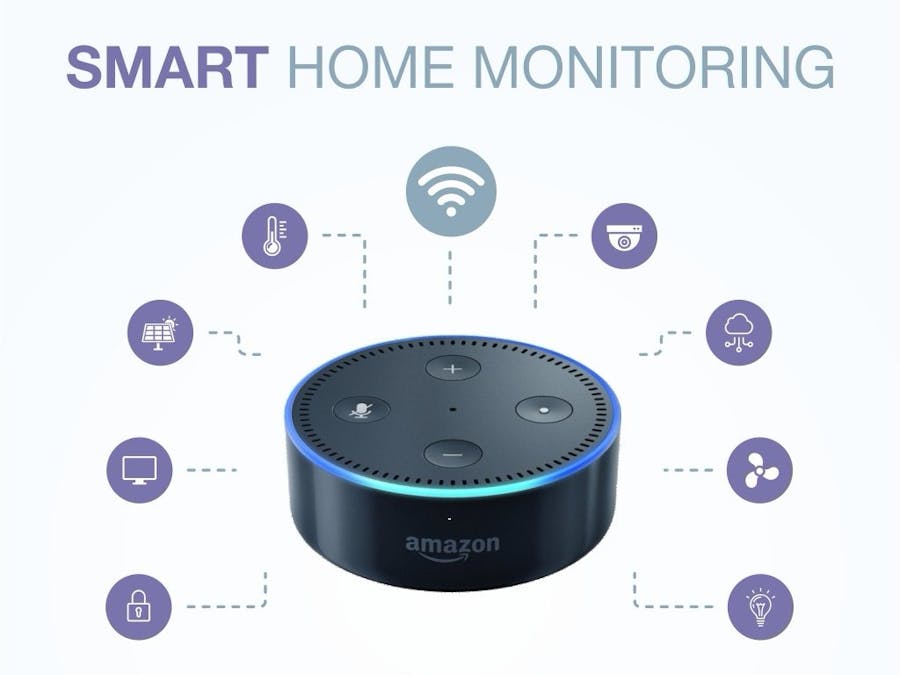
This “IoT” is big and getting bigger and bigger. Gartner reported that 8.4 billion connected “IoT” devices were used in 2017 (31% increased from 2016). It is already bigger than the world’s population. Amazon introduced ‘Alexa’, a virtual assistant cloud based voice service similar to Apple’s Siri that used in Amazon Echo smart speakers. Amazon Echo (speaker) is a hardware and Alexa is a software. They both working together. This smart speaker could do many things including getting the latest news, play music, check the weather forecast, open the garage door, control the connected smart home devices all with your voice.

Image result for alexa
Amazon Echo & other smart devices

Alexa Smart Home

Alexa could help make your home smarter and more automated without having to physically doing it. Your everyday routines would be smarter and easier.

Image result for alexa smart home
Alexa smart home monitoring
  • Smart lighting – let you control your connected light remotely or by voice command when paired with Alexa. User can simply ask Alexa to ‘turn on the kitchen lights‘ or ‘dim the bedroom lights‘.
  • Thermostats – heating and cooling systems can be adjusted easily. Amazon’s Smart thermostats will are able to measure occupancy, with sensors that will make sure your home is in the right temperature.
  • Smart cameras – allows you to instantly monitor and check your home with your voice when connected to Alexa. You can always keep an eye what’s happening in and around your house no matter where you are.
  • Door lockssmart door locks to protect and secure your home. You can give access to other people without the need of key, know who’s home and lock from anywhere. Simply ask “Alexa, is the front door locked?”.

Those are just few of the functions of smart home. There are many more that devices that works well with Alexa. However, security still be one of the concerns of these smart devices. These sensors in our smart homes are collecting extremely sensitive data which could be threat to us as well. We are giving them information of what we are doing at home. The issues of privacy and security are growing concerns for many people as well as for businesses. What are your thoughts about the future of these smart devices? How have ‘internet of things’ changed your life? and are you willing to accept the security and privacy trade-offs to welcome the new era of smart things?

QR Code as a new opportunity for effective mobile marketing

Have you met someone these days who did not have a mobile phone? As we all know, we’re living in the digital age where most of us are connected almost anywhere and anytime. Mobile devices have become an essential part of our lives that some are claimed to ‘not being able to live without it’.

Statista reported that in 2018, there are more than 2.53 billion smartphone users worldwide. There is a huge increased in the penetration rate of mobile devices from 15.6% (2001) to 74.9% (2010), not surprising that marketers are now extending their focus into this new platform.

Related image

So what is ‘mobile marketing’?

According to Kaplan, mobile marketing refers to any marketing activities conducted in which consumers require constant access to combination of networks (internet access while at home and outside) and personal mobile devices. It is the sharing of the brand or business optimised for mobile devices through social media, apps and websites.

Mobile marketing works similar to other types of marketing, with the only difference is that consumers use their mobile phone to reach out and search for our business.

Mobile marketing with QR code

QR code (quick response code) is a 2D barcode that store information (mostly URLs) which is readable by smartphones with a camera. Firstly introduced in automotive industry in Japan in 1994 to track vehicles, these tiny black and white boxes are increasingly gaining popularity across the world and revolutionising mobile marketing.

Image result for qr code
example of QR code

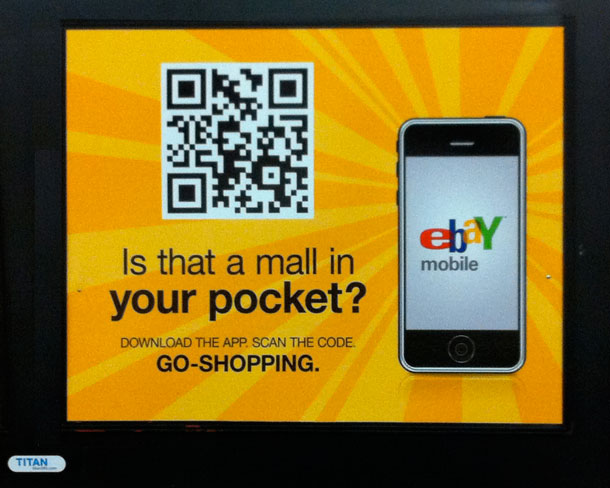
But what is so special about QR code for marketing? convenient is one of its main benefit where users can access to your content with just a simple scan. Since our phone is in our pocket most on the time, scanning can be done quickly and easily. In addition, QR codes are inexpensive, easy to create and universally accessible. QR codes is just like the traditional barcode where we found in almost every products in stores. Today, QR codes have been seen in almost every printed materials including brochures, product packagings, business cards, posters, storefront displays, receipts and many more.

Here are few of the examples of QR codes used in advertising and marketing:

Educational institution, museum and many of public places also use QR codes to provide more information of a particular objects, history or events.

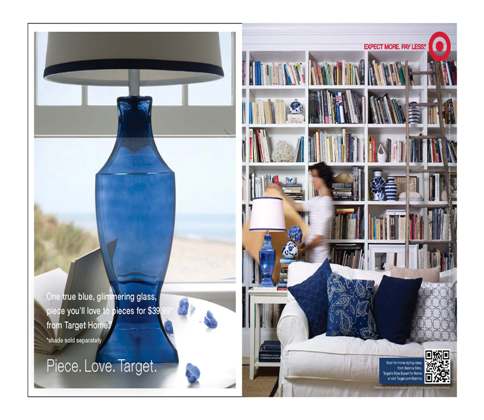
Target ad QR code
Consumers are able to scan the QR codes to read more about the tutorials on home decorations as well as browsing on their home collection

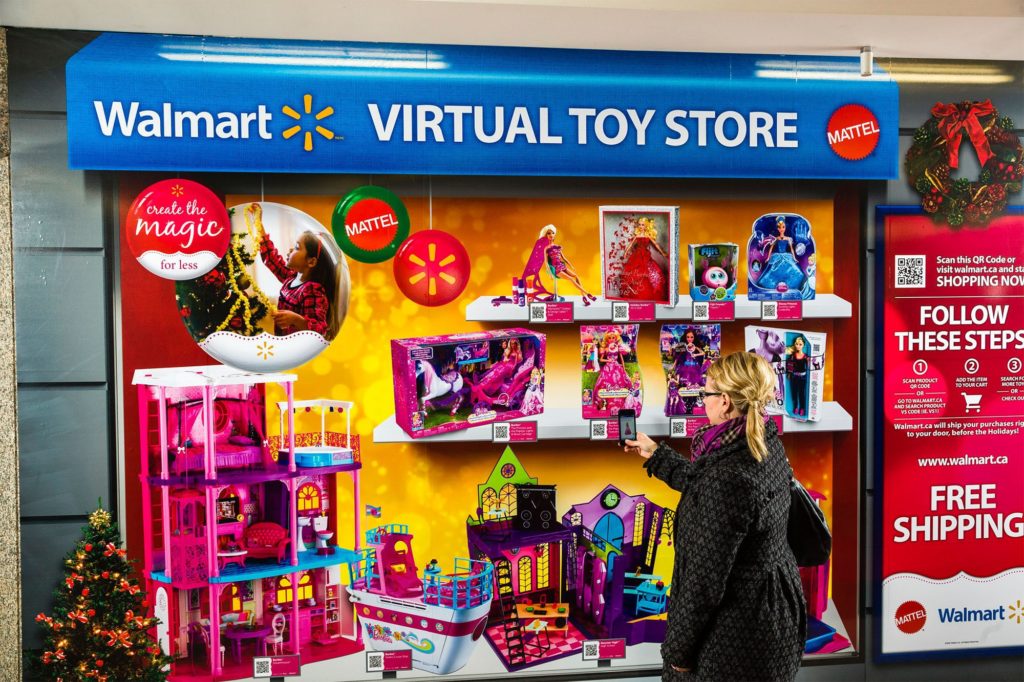
Walmart-Virtual-Store-Effective-QR-Code
Walmart’s Virtual Toy store in Toronto’s underground walkway

Walmart set up a virtual toy store at the busy underground walkway during the festive season. People could scan the code of the toy they are interested in and shop from their smartphones during the holiday rush. In fact, 71% of consumers reported that are more appealing to them compared to online ads. Combination of digital billboard with interactive code, consumers can also look up the for nearest store with GPS on their phone.

Another example is Ralph Lauren’s campaign in which the brand inserted QR code into their magazine ads. By doing this, there is a huge opportunity to reach massive audiences. With less than 10 seconds, customers can simply add this collection to their shopping cart with just a quick scan.

  • customers are able to engage with the brand directly to the site, without the hassle of going through the process of navigating around the search engine.
  • it is trackable, by using web analytics and unique codes, marketers are able to know the effectiveness of the campaign.
  • This little black matrix box are able to store up to 7089 characters (compared to the traditional barcode with just only 20 digits) which means that more information is stored
  • QR code give the opportunity interact with consumers and engage them with their brands.

QR codes are all about immediacy when sometimes customers can’t remember our brand’s name, no time to search for it in the marketplace and all they have to do is just scan and click. It is real time and sometimes invokes the user’s curiosity when they want to know more about a certain product or object. QR code is a simple marketing strategy but when done properly, it can effectively help companies to advertise their products that the traditional billboard cant do. What are your thoughts about the future of QR code in mobile marketing? Do you think it is effective or just similar to other types of marketing?

WoM marketing in beauty industry

Today we move into a digitalised age, where marketers now adopted ‘digital word-of-mouth marketing’ as one of the brand’s strategies for effective advertising. Word of Mouth (WOM) refers to the process where consumers share information about a product or an organisation with one another. People have been sharing reviews, comments about their favourite products with other people for decades either directly in person or on the phone. Today, with smartphones, internet and social media, words are spreading faster and wider than ever.

Here are some facts about WoM.

  • 92% trust recommendations from friends and family over all forms of advertising (Neilsen 2012).
  • 64% of marketing executives believe that WoM is the most effective form of marketing (Forbes 2014).
  • 74% of consumers describes WoM as their key influencer in purchasing decision.
  • BUT, only 33% of businesses are actively seeking out and collecting reviews.

When it comes to beauty products, women will often seek for positive online reviews and recommendation from other women who are currently using the same product. Reviews from people in the community have higher credibility compared to what is claimed by the company on its benefit.

SK-II is one of the well-known skincare product by Procter & Gamble (P&G). SK-II products have a very good market reputation and very popular in Asia. The brand relies heavily on consumers’ word of mouth. Almost every beauty bloggers on social media talk about their best selling product ‘the SK-II facial essence’ or “the miracle water” as it’s called by the beauty community) which is said to enhance and improve the overall quality of our skin.

It’s popularity spread across the world, with a bottle sold every 22 seconds making up to more than 20 million bottles sold worldwide. In the Asian beauty market, they use popular TV celebrities as their brand ambassador which helped them to generate a number of word-of-mouth contents from the fans.

Celebrities, Instagrammers who loves it:

Vanessa Hudgens, an American actress has 33.3 million followers on Instagram. Over 300k people liked that picture which has the potential to reach large audiences. Not just only celebrities but beauty bloggers all around the world also talk about this ‘magic water’

Gucci Westman – make up artist talks about her favourite SK-II products
Youtubers talks about the famous SK II essence

Blogs on ‘SK-II experience’:

https://laurenkaysims.com/2018/04/my-sk-ii-facial-treatment-essence-experience/
http://newdarlings.com/2018/04/my-sk-ii-skin-transformation/

This product is not new, it has been around for 35 years and I have not heard about it before until when I was in high school, there are many of my Facebook’s friends talked about it and posted reviews about this product. Even though I have never used it before due to high cost (might worth an investment) but I believe that every woman will probably know this essence (might have heard from friends or somebody talked about it). Myself, I haven’t done much research about this essence yet but saw so many YouTubers mentioned it which made me aware of this and considering purchasing it and it is quite surprising that even my guy friend in my class knows about this essence haha.


What about you? Have you heard about this essence before? what is your thoughts and comments about Word of Mouth on social platforms? Does it help you to get to know some particular product or brands? Let me know what you think! 🙂 see you next blog!

Online review matters

Easy access to the internet has radically changed the way we shop today. From purchasing a $0.99 phone application to car rental services, it is most unlikely that consumers will make a purchase decision without reading through several online reviews. Pew Internet Survey (2012) reported that 91% of online adults use search engines to find information on the web. 86% of consumers read reviews for local business and 91% trust online reviews as much as personal recommendations (BrightLocal 2018).

Since online reviews are written by consumers, viewers find these information more trustworthy and relatable than marketer generated contents.

A research suggested that online reviews have a strong impact on consumer buying behaviours (Lee, SH & Ro, H 2016).

  • Favourable online consumer reviews increase sales of books, movies, video games, etc.
  • Positive consumer ratings and reviews has shown a positive association towards hotel reservation and restaurant visit intentions (such as review from Yelp, Zomato, TripAdvisor..)
  • In the case study of Yelp.com, it has been found a 5-9% increase in restaurant revenue for a one-star increase in Yelp rating.

Positive reviews

A brand can build trust and credibility from positive reviews. People will be looking for online testimonials and reviews from the current customers to make a decision on giving the brand/business a try. The more people are talking about your brand, the more visibility it is, which help to create a positive word of mouth, sharing contents on the social platform and finally increase in the sales.

Beauty blogger review on Foreo’s Luna Mini 2
Review of Foreo’s user with ‘#FOREO’ on Instragram

One of the examples is from the brand Foreo, a facial cleanser product for effective cleansing. From the positive reviews I’ve read online both from their website and other sites, it has a positive impact on my purchase decision. Also, there are so many beauty bloggers posted a video on YouTube to recommend this product. Consumers turn to these bloggers and vloggers for unbiased reviews which as a result viewers tend to trust their recommendation. From a poll by London Beauty Queen, it showed that 47% of people had made a ton of purchases based on the blog recommendation and 46% had made a few. And only 7% hadn’t made any purchases based on the bloggers.

Negative reviews

A survey from ReviewTracker (2018), found that negative reviews convinced 94% of consumers surveyed to avoid a particular business. As a customer myself, when looking for a place to eat I often go to Zomato.com to check out for the restaurants. Most of the time I tend to avoid restaurants with a rating of 3 stars and below. Sometimes even with a famous restaurant, I often check for the most recent negative reviews on customers’ complaints. Most of the time, these complaints have an impact on my decision on visiting those restaurants, some business doesn’t handle with those negative feedback from their customers properly and some not even apologise to their upset customers.

TGI Fridays’ rating on Zomato.com
  • The overall rating of TGI Fridays are low to average rate, which could possibly have an on impact their overall reputation.

Customer review on TGI Fridays Melbourne central on Zomato.com

As a customer, what do you guys think about online reviews? Does all these positive or negative comments have any impact on your decision making process? Let me know your thoughts, see you next blog!

The power of social media influencer

For the past few years, influencer marketing has become wildly popular among teenagers and adult in various social media platforms. Many of us use social networking site such as Facebook, Instagram or Twitter to follow celebrities, public figure or famous people’s lives and at the same time, they are unconsciously influencing us on our thoughts, and feelings about a particular things. Us, social media users seen influencers as a trusted source of information because of his/her authority, knowledge and position about that industry and the market.

There is a relationship between a brand and an influencer. An influencer works independently to promote for products or services for a brand which mostly rely on the trust and loyalty they have built with their followers.

With the rise of technologies, easily accessible of internet connection makes influencer marketing a truly global phenomenon. One of the example is Kayla Itsines and her online presence.

Kayla Itsines, “The Internet’s Workout Queen” – Forbes.

Kayla Itsines is one of the fitness influencer on social media. With 11.2 Million followers on Instragram who inspires and influences women across the world towards a healthier lifestyle. As a fitness trainer, Kayla decided to make her presence online and constantly uploads her client’s transformation on social media site which later gain reputation as a fitness influencer who is able to have hundreds of thousands women worldwide subscribing on Itsines’ Bikini Body Training Guide program of $19.99 a month. Her fitness app ranked as the most downloaded app on iOS and google play in 2016 which were able to generated $17 million in revenues, (Forbes 2017).

Kayla Itsines’s post on Instagram

Another example of a well known influencer on social media is Gigi Hadid, an American fashion model who has 46.7 million followers on Instagram.

Gigi Hadid’s Instagram profile

As a modelling career, Hadid has gone to work with a lot of leading designer brands ranging from Tom Ford and Versace to Reebok and Victoria’s Secret (Biography, 2018). She continuously appear on international magazine cover and walk on the runways at every major fashion week.

One of the recent collaboration was Gigi Hadid with Tommy Hilfiger, an American premium clothing brand which Gigi was asked to design the TommyxGigi collection for Tommy Hilfiger brand. According to WWD, Gigi’s ambassadorship display a fantastic effect on their business. Within the first two days of the presentation, there was a 900 percent increase in the traffic to the brand’s website and 70% are new visitors.

Gigi Hadid collaboration with Tommy Hilfiger

As a model and fashion influencer, her ambassadorship for Tommy Hilfiger had created a ‘halo effects’ across the regions, resulting in a double-digit sales growth across the women’s categories.

According to Forbes, industry experts suggest a price point of around $1000 per 100,000 followers on Instagram, and standard price of $100 per 1000 views on YouTube. Marketers are questioning whether those marketing and advertising budget are worth investment? How will the effectiveness of influencer marketing being measured and will social media be the best solution to reach larger target audiences? What are your thoughts about social media influencer? Are they really powerful and effective for marketing? Feel free to leave a comment below! 🙂